
A roof sheds an enormous amount of water in every storm. The gutter system’s job is to catch that water at the roof edge and release it where it can flow away from the house, instead of pouring down the siding and soaking the ground beside the foundation.
It only works as a system. The gutter has to be sized for the roof, hung on sound fascia with strong hangers, pitched toward its outlets, closed off with sealed or soldered end caps, corners and seams, and connected to downspouts big enough to carry the water down and away.
This guide explains each part: what it is, why it’s used, how it should be installed and what goes wrong when it isn’t. Code references are to the International Residential Code (IRC); your town’s adopted code and the product’s instructions always govern. For the roof edge above the gutter, see Parts of a Roof, Explained.
Key takeaways
- Gutters protect the foundation, basement, siding and landscaping by catching roof water and releasing it away from the house.
- A gutter must be sized for the roof (5-inch for most homes, 6-inch for large or steep roofs) and pitched toward its outlets so water never sits in it.
- Hidden hangers screwed into sound fascia hold far better than old spike-and-ferrule nails.
- Every joint is a possible leak: end caps, corners, outlets and seams must be sealed on aluminum and soldered on copper.
- Downspouts and elbows carry the water down; splash blocks or extensions move it away from the foundation.
- Gutter guards cut down on cleaning, but no guard is maintenance-free and none can fix a sagging or poorly pitched gutter.
Quick Reference
| Part | What it is | Purpose |
|---|---|---|
| Gutter (K-style & half-round) | A gutter is the open metal channel fastened along the roof edge that catches the water running off the roof and carries it to a downspout. | Catches the water coming off the roof and carries it to the downspouts, so it doesn’t pour down the siding, splash against the foundation or wash out the landscaping. |
| Slope (pitch) | Gutter slope (or pitch) is the slight, steady fall a gutter is hung with along its length, so water runs toward the downspout outlet instead of sitting in the trough. | Keeps water moving toward the outlet so it never sits in the gutter, where it adds weight, freezes and breeds clogs. |
| Hangers | Gutter hangers are the brackets that hold a gutter to the fascia and keep its shape under the weight of water, snow and ice. | Hold the gutter tight to the fascia and keep its shape and slope under the weight of water, snow and ice. |
| End caps | An end cap is the piece that closes the end of a gutter run so water can only leave through the outlet. | Close off the end of the gutter so water can only leave through the outlet. |
| Inside & outside miters | A miter is the corner piece where two gutter runs meet: an outside miter wraps an outside corner of the house, and an inside miter turns an inside corner. | Turn the gutter around a corner of the house in one watertight piece, so water from both roof planes stays in the gutter. |
| Seams & sealant | A seam is any joint in a gutter system: where two lengths meet, at corners, end caps and outlets. | Keep every joint in the gutter system watertight, so water leaves only through the outlets. |
| Downspout outlets (drop outlets) | A downspout outlet (also called a drop outlet) is the short tube set into the bottom of the gutter where the water drains out into the downspout. | Let the water out of the bottom of the gutter and into the downspout. |
| Elbows (A & B) | A downspout elbow is an angled fitting that changes the direction of a downspout: at the top, two elbows and a short piece of pipe bring it from the gutter back to the wall, and at the bottom an elbow turns the water away from the house. | Change the downspout’s direction, bringing it back to the wall at the top and turning the water away from the house at the bottom. |
| Downspouts | A downspout (also called a leader) is the vertical pipe that carries water from the gutter outlet down the wall to the ground or to an underground drain. | Carry the water from the gutter down to the ground or a drain, so it’s released where it can flow away from the house. |
| Downspout straps | Downspout straps (also called bands or brackets) are the metal straps that fasten a downspout to the wall. | Hold the downspout tight to the wall so it can’t swing, sag or come apart. |
| Splash blocks & extensions | A splash block is a sloped pad set on the ground under the end of a downspout, and a downspout extension is a length of pipe that carries the water farther out, so roof water lands away from the foundation instead of right beside it. | Move the water away from the foundation so it can’t soak the soil next to the basement. |
| Gutter apron / drip edge | A gutter apron is a strip of metal flashing that runs from under the first row of shingles down into the back of the gutter, bridging the gap so water can’t run behind the gutter. | Bridges the gap between the roof edge and the back of the gutter so water can’t run behind the gutter onto the fascia. |
| Fascia | The fascia is the long, flat board along the roof edge that the gutters are fastened to; every hanger screws into it, so it carries the full weight of the gutters and the water in them. | Gives the gutters a solid board to hang on and closes off the roof edge. |
| Leaf guards / gutter guards | Gutter guards (also called leaf guards) are covers or inserts installed on top of or inside the gutter that keep leaves, needles and debris out while letting water in. | Keep leaves and debris out of the gutter so it keeps flowing, with less cleaning. |
Part 1 · The gutter
The trough itself, how it’s hung, and how its ends, corners and joints are closed.
The Gutter
Also called: gutter trough, eavestrough, rain gutterA gutter is the open metal channel fastened along the roof edge that catches the water running off the roof and carries it to a downspout. The two main shapes are K-style, with a flat back and a decorative front that looks like crown molding, and half-round, a rounded trough.
PurposeCatches the water coming off the roof and carries it to the downspouts, so it doesn’t pour down the siding, splash against the foundation or wash out the landscaping.
- K-style
- The most common shape on homes. Its flat back sits tight to the fascia, and it holds more water than a half-round gutter of the same width.
- Half-round
- A smooth, rounded trough that drains cleanly and has a traditional look; the usual choice on slate, cedar and historic homes, often in copper.
- 5-inch vs. 6-inch
- The size is the width across the top. 5-inch is the standard for most homes; 6-inch carries considerably more water and suits large or steep roofs and long runs.
- Seamless vs. sectional
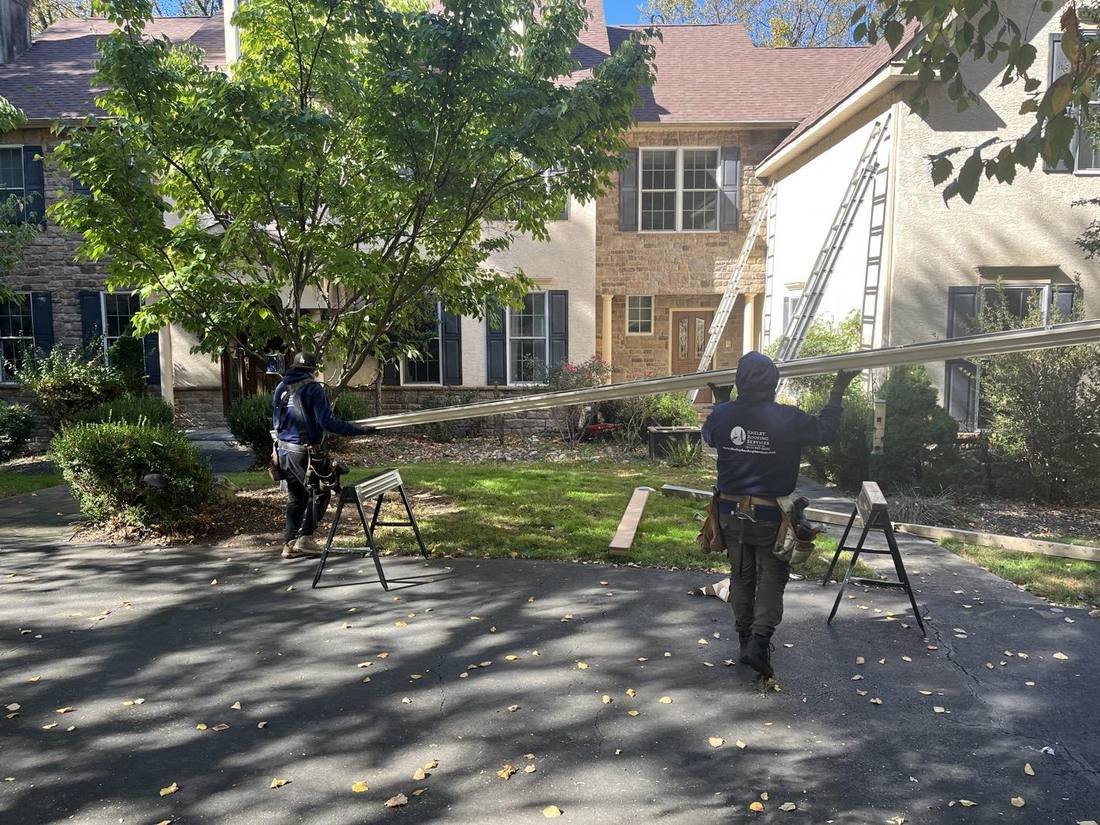
- Seamless gutters are formed on site from a coil of aluminum into one continuous length for each run, so the only joints are at corners and outlets. Sectional gutters come in short lengths joined with connectors, and every joint is a possible leak.
How it’s installed
- The roof is measured and the gutter size is chosen for the roof area and pitch.
- Each run is formed to length (seamless) or cut and joined (sectional or copper).
- The run is hung on the fascia with hangers, set to slope toward its outlets.
- Corners, end caps and outlets are sealed (or soldered on copper), and the downspouts are connected.
What goes wrong
- A gutter too small for the roof, so it overflows in heavy rain.
- Gutters that hold standing water because the slope is flat or backwards.
- Sectional gutters with leaking joints every few feet.
We install K-style and half-round aluminum gutter systems in 5- and 6-inch sizes, chosen for each roof’s size and pitch, and custom-fabricated copper gutters for slate, cedar and premium homes. Old gutters and downspouts are completely removed; we don’t reuse or work around old components.
Gutter Slope (Pitch)
Also called: gutter pitch, gutter fallGutter slope (or pitch) is the slight, steady fall a gutter is hung with along its length, so water runs toward the downspout outlet instead of sitting in the trough.
PurposeKeeps water moving toward the outlet so it never sits in the gutter, where it adds weight, freezes and breeds clogs.
- How much
- Gentek’s installation guide calls for a fall of at least 1/4 inch per 10 feet of run toward the nearest outlet. More fall drains faster, but too much is visible from the street.
- Long runs
- SMACNA treats 50 feet as a practical maximum length of gutter served by one downspout, to limit thermal expansion; longer runs are pitched from the middle down to a downspout at each end.
- Why it matters
- Standing water adds weight, freezes in winter, and leaves the sludge that clogs outlets and rots gutters from the inside.
What goes wrong
- A flat or back-pitched gutter that holds water after every rain.
- Hangers that have loosened, letting part of the run sag into a low spot.
Our gutters are pitched toward the downspouts to the manufacturer’s specifications for that gutter profile, size and run length, so water drains properly and never stands in the gutter.
Gutter Hangers
Also called: gutter brackets, hidden hangers, spike and ferruleGutter hangers are the brackets that hold a gutter to the fascia and keep its shape under the weight of water, snow and ice.
PurposeHold the gutter tight to the fascia and keep its shape and slope under the weight of water, snow and ice.
- Hidden hangers
- Brackets that clip inside the front lip of the gutter and screw through the back into the fascia. They’re strong, hidden from view and don’t loosen the way nails do.
- Spike and ferrule
- The older method: a long nail through the front of the gutter and a tube (ferrule) to the fascia. Over time the spikes work loose and the gutter pulls away.
- Brackets and straps
- Half-round gutters usually hang in round brackets or straps, fastened to the fascia or to the roof deck under the shingles.
- Spacing
- Set by the manufacturer for the gutter profile, size and material, and tightened where snow and ice load the gutters. See the table below.
Hanger spacing by gutter type
| Gutter | Manufacturer spacing | Source |
|---|---|---|
| Aluminum K-style, hidden hangers | One hanger every 24 inches of run; closer (about 18 inches) in heavy snow and ice areas | Amerimax and Euramax hanger specs; U.S. Aluminum |
| Half-round (copper or aluminum) | 16 inches, or 24 to 36 inches on center, depending on the application and expected snow loads | K&M Sheet Metal half-round hangers |
| Copper hung gutters | No more than 30 inches on center in snow areas, 36 inches elsewhere; strap hangers with a stiffening bar for gutters wider than 6 inches or severe ice and snow | Copper Development Association |
Always follow the specific gutter and hanger manufacturer’s current instructions.
What goes wrong
- Hangers spaced too far apart, so the gutter sags between them.
- Spike-and-ferrule fasteners pulling out of the fascia.
- Aluminum or steel hangers on copper gutters, which can cause galvanic corrosion.
We install gutters with hidden hangers rather than spike-and-ferrule systems, spaced to the manufacturer’s specifications for that gutter profile, size and run length. Copper gutters are hung with durable hardware designed for copper.
End Caps
Also called: gutter end cap, end pieceAn end cap is the piece that closes the end of a gutter run so water can only leave through the outlet.
PurposeClose off the end of the gutter so water can only leave through the outlet.
- Where it goes
- At every open end of a gutter run, typically where a roof edge ends at a gable or a wall.
- How it’s attached
- On aluminum gutters, the cap is crimped or riveted on and sealed. On copper gutters, it’s soldered in place.
What goes wrong
- A dried-out bead of sealant, so the end drips or stains the fascia.
- A cap pushed off by ice or a sagging gutter.
All seams, outlets and end caps are sealed on our aluminum gutters, and every joint on our copper gutters is soldered.
Corner Miters
Also called: gutter corners, inside miter, outside miter, box miterA miter is the corner piece where two gutter runs meet: an outside miter wraps an outside corner of the house, and an inside miter turns an inside corner.
PurposeTurn the gutter around a corner of the house in one watertight piece, so water from both roof planes stays in the gutter.
- How they’re made
- Cut from the gutter itself or bought as preformed corners, then joined to the runs.
- Why corners matter
- Corners collect water from two roof planes and are joints, so they’re a common place for leaks and overflow.
- Copper
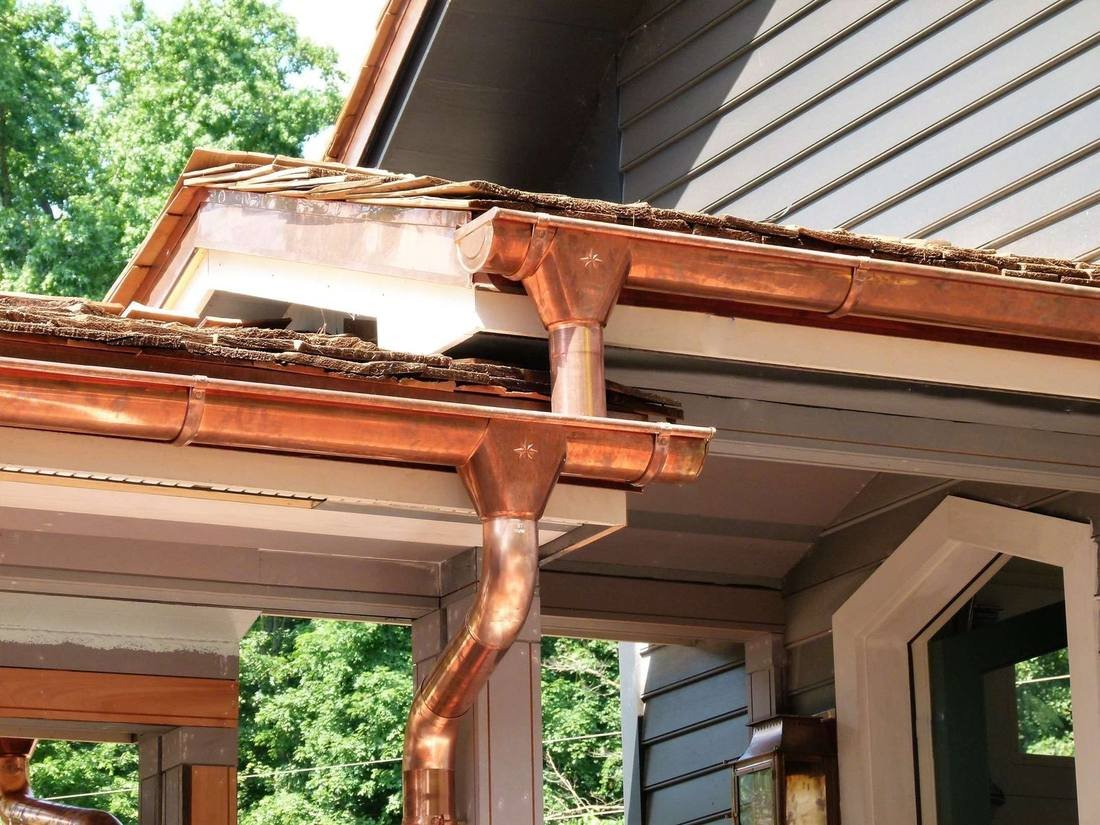
- Copper corners are soldered into one watertight piece.
What goes wrong
- Leaks at the corner joint once the sealant fails.
- Water from a valley overshooting the corner in heavy rain.
On our copper systems, corners and every other joint are soldered, not sealed with caulk, like the corner shown above.
Seams and Gutter Sealant
Also called: gutter joints, gutter seal, solder jointsA seam is any joint in a gutter system: where two lengths meet, at corners, end caps and outlets. Seams on aluminum gutters are sealed with gutter sealant; seams on copper gutters are soldered.
PurposeKeep every joint in the gutter system watertight, so water leaves only through the outlets.
- Gutter sealant
- A flexible sealant made for gutters, applied inside the joint where it stays covered and protected.
- Solder
- On copper, the joint is heated and fused with metal solder, which lasts as long as the copper itself.
- Fewer seams
- Seamless gutters cut the number of seams down to corners, end caps and outlets.
What goes wrong
- Old sealant that has cracked or pulled away, so the joint drips.
- Sealant smeared over a dirty or wet joint, where it never bonds.
All seams, outlets and end caps are properly sealed on our aluminum gutters, because these are the most common failure points in a gutter system. Copper gutters are soldered at every joint.
Gutter Materials Compared
Gutters are made from several materials. Here is how they compare on a home.
| Material | Where it’s used | Good to know |
|---|---|---|
| Aluminum | Most homes; K-style and half-round; seamless runs | Lightweight, rust-free and available in many colors. Gutter coil is made in 0.027-inch and heavier 0.032-inch thicknesses (Alsco, Gentek); the heavier gauge is often chosen for high wind and heavy rain. |
| Copper | Slate, cedar, designer-shingle and historic homes; usually half-round | Soldered joints and a natural patina that turns brown, then green. Copper must be paired with copper-compatible hangers, straps and downspouts to avoid galvanic corrosion. |
| Galvanized or Galvalume steel | Homes and buildings that need extra strength | Stronger than aluminum, but cut edges and scratches are where it rusts first. |
| Vinyl | Sectional do-it-yourself systems | Light and simple to install, but more joints, and it can become brittle in cold weather. |
We install aluminum gutter systems, the most common choice in our area, and custom-fabricated copper systems with soldered joints, each to the manufacturer’s specifications for that gutter profile and size. Properly installed aluminum gutters last 20 to 30 years; properly installed copper gutters last 50 years or more.
Part 2 · Getting water down and away
From the outlet to the ground: the parts that carry roof water away from the house.
Downspout Outlets
Also called: drop outlet, gutter outlet, outlet tubeA downspout outlet (also called a drop outlet) is the short tube set into the bottom of the gutter where the water drains out into the downspout.
PurposeLet the water out of the bottom of the gutter and into the downspout.
- Where it goes
- At the low end of each gutter run, or at both ends and the middle of long runs.
- How it’s installed
- A hole is cut in the bottom of the gutter, the outlet is fitted through it and riveted and sealed (soldered on copper).
- Sizing
- The outlet matches the downspout size and shape: rectangular for 2x3 or 3x4 downspouts, round for round downspouts.
What goes wrong
- An outlet clogged with leaves, the most common cause of a gutter overflowing at one spot.
- Too few outlets for a long run or a large roof.
Outlets are sealed with the rest of the joints on our aluminum gutters and soldered on our copper gutters.
Downspout Elbows
Also called: A elbow, B elbow, offsetA downspout elbow is an angled fitting that changes the direction of a downspout: at the top, two elbows and a short piece of pipe bring it from the gutter back to the wall, and at the bottom an elbow turns the water away from the house.
PurposeChange the downspout’s direction, bringing it back to the wall at the top and turning the water away from the house at the bottom.
- A elbows
- Bend front to back, toward or away from the wall. They’re used to bring the downspout from the gutter back to the house, and at the bottom to kick the water out.
- B elbows
- Bend side to side, left or right along the wall, for example to clear a window or follow a corner.
- Why they’re used
- The gutter sits out from the wall on the fascia, so elbows let the downspout hug the wall where it can be strapped, and steer the water where it can drain away.
What goes wrong
- Elbows assembled with the upper piece outside the lower one, so water leaks out of every joint.
- A sharp, crowded elbow that catches debris and clogs.
Downspouts
Also called: leader, downpipe, conductorA downspout (also called a leader) is the vertical pipe that carries water from the gutter outlet down the wall to the ground or to an underground drain.
PurposeCarry the water from the gutter down to the ground or a drain, so it’s released where it can flow away from the house.
- Sizes
- Rectangular 2x3-inch and the larger 3x4-inch are the common sizes on homes; round downspouts usually go with half-round gutters.
- Sizing method
- SMACNA sizes gutters and downspouts from the roof’s drainage area and the local design rainfall intensity (a 5-minute storm), and notes that a downspout should not be wider than the bottom of the gutter.
- Placement
- Downspouts go where the water can be led away from the house; SMACNA treats 50 feet as a practical maximum length of gutter for one downspout.


Downspout sizes at a glance
| Downspout | Opening | Roof area, rule of thumb |
|---|---|---|
| 2x3 rectangular | About 6 sq in | About 600 sq ft |
| 3x4 rectangular | About 12 sq in | About 1,200 sq ft |
| 3-inch round | About 7 sq in | About 700 sq ft |
| 4-inch round | About 12.5 sq in | About 1,250 sq ft |
Rule of thumb: about 1 square inch of downspout per 100 square feet of roof at moderate rainfall (This Old House; the 2x3 and 3x4 figures are theirs, the round figures apply the same rule). Steep roofs and heavier design rainfall call for more capacity; SMACNA’s method uses local rainfall data.
What goes wrong
- Too few or too small downspouts for the roof, so gutters overflow even when they’re clean.
- Downspouts that empty right at the foundation.
- Aluminum downspouts on copper gutters, which mixes metals that don’t belong together.
Our downspouts are sized and placed to the manufacturer’s specifications for the gutter profile, size and run length, installed to direct water away from the foundation and landscaping, and copper gutters get matching copper downspouts.
Downspout Straps
Also called: downspout brackets, bandsDownspout straps (also called bands or brackets) are the metal straps that fasten a downspout to the wall.
PurposeHold the downspout tight to the wall so it can’t swing, sag or come apart.
- Where they go
- Along the length of the downspout, so it can’t pull away from the wall or come apart at its joints.
- Materials
- Matched to the downspout: aluminum straps on aluminum, copper straps on copper.
What goes wrong
- Missing straps, so the downspout swings in the wind and separates from the outlet.
- Steel or aluminum straps on copper downspouts.
On copper systems, the straps, hangers and downspout connections are all copper-compatible to prevent galvanic corrosion.
Splash Blocks and Downspout Extensions
Also called: splash pad, downspout extension, leader extensionA splash block is a sloped pad set on the ground under the end of a downspout, and a downspout extension is a length of pipe that carries the water farther out, so roof water lands away from the foundation instead of right beside it.
PurposeMove the water away from the foundation so it can’t soak the soil next to the basement.
- Grading (code)
- IRC R401.3 calls for the ground to slope away from the foundation, falling at least 6 inches within the first 10 feet.
- Discharge (code)
- Where expansive or collapsible soils are known to exist, IRC R801.3 requires roof drainage to discharge at least 5 feet from foundation walls or into an approved drainage system.
- Other options
- Downspouts can also connect to an underground drain line, where one is in place and approved locally.
What goes wrong
- A downspout that empties against the foundation, the classic cause of a wet basement.
- A splash block turned the wrong way, sending water back toward the house.
- Extensions knocked off by a mower and never put back.
Proper downspout placement is critical: on our installations, water is discharged far enough from the structure to prevent long-term damage, following the manufacturer’s specifications and local code.
Part 3 · Where the gutter meets the roof
The flashing and board the gutter depends on.
Gutter Apron and Drip Edge
Also called: gutter apron, drip edge, Type F drip edgeA gutter apron is a strip of metal flashing that runs from under the first row of shingles down into the back of the gutter, bridging the gap so water can’t run behind the gutter. It’s a drip edge profile (Type F) with a longer leading edge.
PurposeBridges the gap between the roof edge and the back of the gutter so water can’t run behind the gutter onto the fascia.
- Where it goes
- Along the eave, between the roof edge and the back of the gutter.
- Drip edge
- A standard drip edge along the eave also directs water off the roof edge into the gutter; see our roof guide’s drip edge section.
- Why it matters
- Without it, water can wick behind the gutter, soak the fascia and rot the edge of the roof deck.
What goes wrong
- No drip edge or gutter apron, so water runs down the fascia behind the gutter.
- Gutters hung so low under the drip edge that water drips between them.
Drip edge is installed along the roof edges on every new shingle roof we install, and gutters are hung to the manufacturer’s specifications so the water lands in the gutter, not behind it.
Fascia
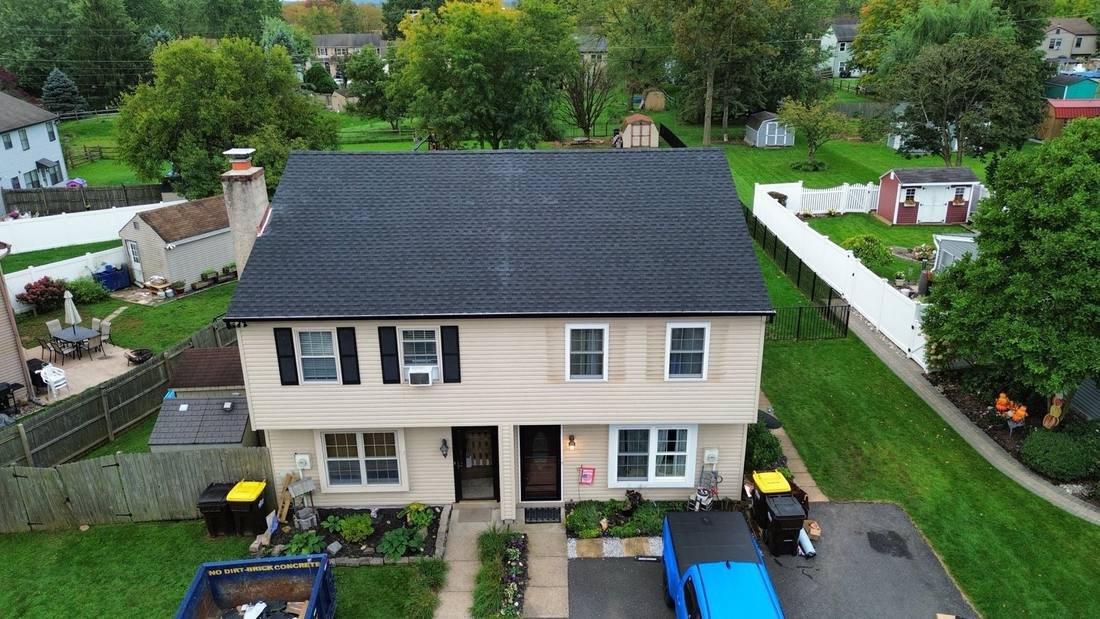
Also called: fascia boardThe fascia is the long, flat board along the roof edge that the gutters are fastened to; every hanger screws into it, so it carries the full weight of the gutters and the water in them.
PurposeGives the gutters a solid board to hang on and closes off the roof edge.
- What to look for
- Peeling paint, soft or stained wood behind the gutters, and gutters pulling away from the house.
- More detail
- Materials, installation and aluminum fascia wrap are covered in our roof guide’s fascia board section.
What goes wrong
- New gutters hung on rotted fascia that can’t hold the hangers.
- Overflowing or leaking gutters soaking the fascia until it rots.
The fascia is inspected for rot, damage or deterioration before every gutter installation. Gutters mount directly to it, so any damaged fascia is addressed before installation begins.
Part 4 · Protection
Keeping the system clear.
Gutter Guards
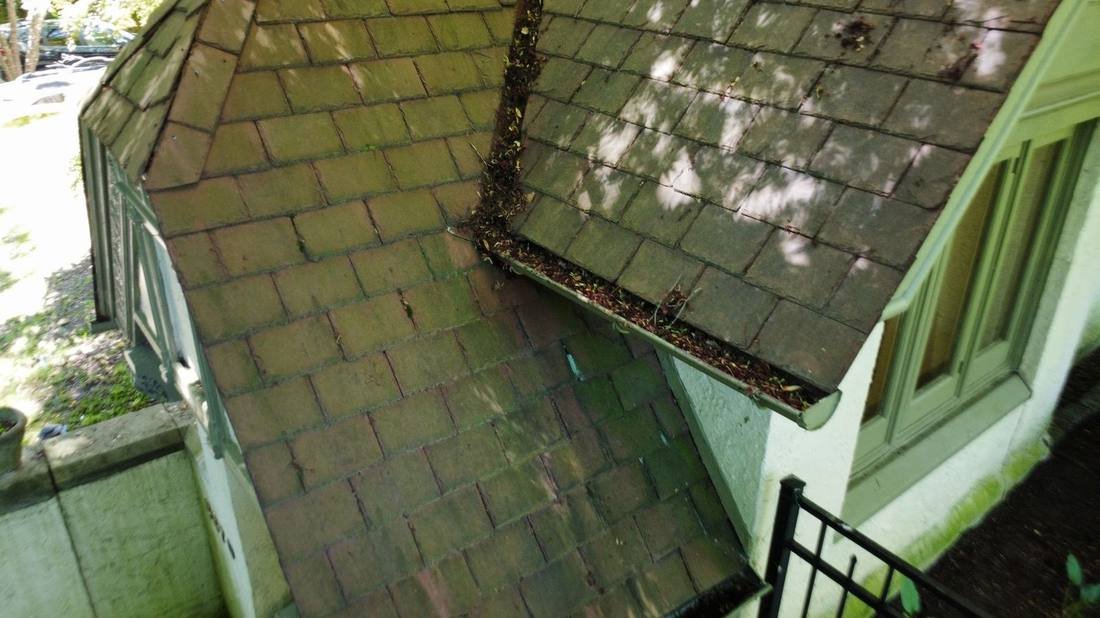
Also called: leaf guards, gutter covers, gutter protectionGutter guards (also called leaf guards) are covers or inserts installed on top of or inside the gutter that keep leaves, needles and debris out while letting water in.
PurposeKeep leaves and debris out of the gutter so it keeps flowing, with less cleaning.
- Screen
- A perforated or wire screen over the gutter. Simple and effective against large leaves; smaller debris can pass through.
- Micro-mesh
- A fine stainless or aluminum mesh that blocks even pine needles and seeds. Fine grit can collect on top and occasionally needs brushing or rinsing off.
- Reverse curve (surface tension)
- A solid cover with a rounded front edge: water follows the curve into the gutter while debris slides off. It must be set precisely, or water can run past the gutter in heavy rain.
- Foam and brush
- Inserts that sit inside the gutter. Easy to install, but they can hold debris and moisture and need more upkeep.
- Why they’re used
- To keep gutters and outlets flowing, cut down on ladder cleaning and protect the fascia and foundation from overflow.
- Limits
- No guard is maintenance-free, and a guard can’t fix a gutter that is undersized, sagging or pitched wrong. Guards that slide under the shingles must follow the guard and shingle manufacturers’ instructions.
How it’s installed
- The gutters are inspected first; damaged, misaligned or poorly pitched gutters are corrected before any guard goes on.
- The gutters are thoroughly cleaned.
- A guard type is chosen for the roof pitch, tree coverage, debris type and water flow.
- The guard is fastened to the gutter and integrated with the roof edge so water can’t bypass it.
What goes wrong
- Guards installed over dirty, sagging or back-pitched gutters.
- A reverse-curve guard set at the wrong angle, so water overshoots in a downpour.
- A fine mesh left covered in grit and seed pods for years.
We install mesh (our most popular), surface-tension and screen guards, matched to each property after evaluating roof pitch, tree coverage, debris type and water flow. Every installation starts with a cleaning, damaged gutters are corrected first, and guards are integrated with the roof edge and gutter so water can’t bypass the system.
Questions & Answers
Straight answers to the gutter questions homeowners ask us most.
What are the parts of a gutter system?
A gutter system is made of the gutters themselves, the hangers that hold them to the fascia, end caps, corner miters and sealed (or soldered) seams, downspout outlets, elbows, downspouts and the straps that hold them, splash blocks or extensions at the bottom, the gutter apron or drip edge at the roof edge, and, where used, gutter guards.
What is the purpose of gutters?
Gutters catch the water running off the roof and carry it to downspouts that release it away from the house. That protects the foundation, basement, siding, windows and landscaping from the water a roof sheds in every storm.
What is the difference between K-style and half-round gutters?
K-style gutters have a flat back and a decorative front like crown molding, and they hold more water than a half-round gutter of the same width; they’re the most common gutter on homes. Half-round gutters are rounded troughs with a traditional look, the usual choice on slate, cedar and historic homes, often in copper.
Do I need 5-inch or 6-inch gutters?
5-inch gutters suit most homes. 6-inch gutters carry considerably more water and are used on large or steep roofs, long runs and roofs that send a lot of water to one spot. The right size depends on the roof’s area and pitch, which is why we size gutters during the inspection.
What are gutter hangers, and how far apart should they be?
Gutter hangers are the brackets that hold the gutter to the fascia, and their spacing follows the manufacturer. Aluminum K-style hidden hangers are specified at one every 24 inches of run (closer, about 18 inches, in heavy snow); half-round hangers at 16 to 36 inches depending on snow load; and the Copper Development Association limits copper gutter hangers to 30 inches in snow areas and 36 inches elsewhere.
Are hidden hangers better than spike and ferrule?
Yes. Hidden hangers clip inside the gutter and screw into the fascia, so they hold tight and stay out of sight. Spike-and-ferrule systems use long nails that work loose over time, letting the gutter pull away. Shelby Roofing Services installs hidden hangers.
How much slope should a gutter have?
Gutters need a slight, steady fall toward the outlet; Gentek’s installation guide calls for at least 1/4 inch per 10 feet of run. SMACNA treats 50 feet as a practical maximum run for one downspout, so longer runs are pitched from the middle to a downspout at each end.
What is the difference between A and B downspout elbows?
A elbows bend front to back, toward or away from the wall; they bring the downspout from the gutter back to the house and turn the water out at the bottom. B elbows bend side to side, left or right along the wall.
What size downspout do I need?
A common rule of thumb is about 1 square inch of downspout for every 100 square feet of roof: a 2x3-inch downspout handles roughly 600 square feet and a 3x4-inch about 1,200 square feet at moderate rainfall; 3- and 4-inch round downspouts work the same way. SMACNA’s sizing method uses the roof area and local design rainfall, and a downspout should not be wider than the bottom of the gutter.
What are gutter end caps and drop outlets?
An end cap closes the end of a gutter run. A drop outlet is the short tube set into the bottom of the gutter that drains water into the downspout. Both are joints, so they’re sealed on aluminum gutters and soldered on copper.
Are seamless gutters better?
Seamless gutters are formed on site into one continuous length for each run, so the only joints are at corners, end caps and outlets. Fewer joints means fewer places to leak than sectional gutters joined every few feet.
Do gutter guards really work?
A well-matched guard keeps most leaves and debris out and cuts down on cleaning, but no guard is maintenance-free. Micro-mesh blocks even pine needles but can collect fine grit; reverse-curve guards must be set precisely; foam and brush inserts need more upkeep. A guard also can’t fix a gutter that is undersized, sagging or pitched wrong.
What is a gutter apron?
A gutter apron is a strip of metal flashing from under the first row of shingles down into the back of the gutter, so water can’t run behind the gutter and soak the fascia. It’s a drip edge profile (Type F) with a longer leading edge.
How far from the house should a downspout drain?
The ground should slope away from the foundation, falling at least 6 inches within the first 10 feet (IRC R401.3). Where expansive or collapsible soils exist, IRC R801.3 requires roof drainage to discharge at least 5 feet from foundation walls or into an approved drainage system.
Why do my gutters overflow?
The usual causes are a clogged outlet or downspout, a gutter pitched flat or backwards, sagging sections, too few or too small downspouts for the roof, or water from a valley rushing past a corner. Cleaning fixes the first; the others need the gutter re-hung, resized or given more outlets.
Why are copper gutters soldered instead of caulked?
Soldering fuses the copper pieces with metal, so the joint lasts as long as the copper itself. Sealants dry out and fail over time. Every joint on Shelby Roofing Services’ copper gutters is soldered.
Keep Exploring
Gutters overflowing, sagging or pulling away from the house? A free inspection shows you why, from the fascia to the downspouts.

